NDIS Funding Cuts Explained: What They Could Mean for Your Plan
Some NDIS support budgets are being reduced from October 2026. Find out which plans and supports are affected, what is excluded and what participants can do next.
Last updated: 29 October 2026
From 1 October 2026, funding cuts began to apply to some NDIS support budgets.
That does not mean every participant has had their whole NDIS plan cut. The changes apply to funding within two particular groups of supports. They take effect progressively when the NDIA creates, reassesses or renews an affected plan.
The two affected groups are:
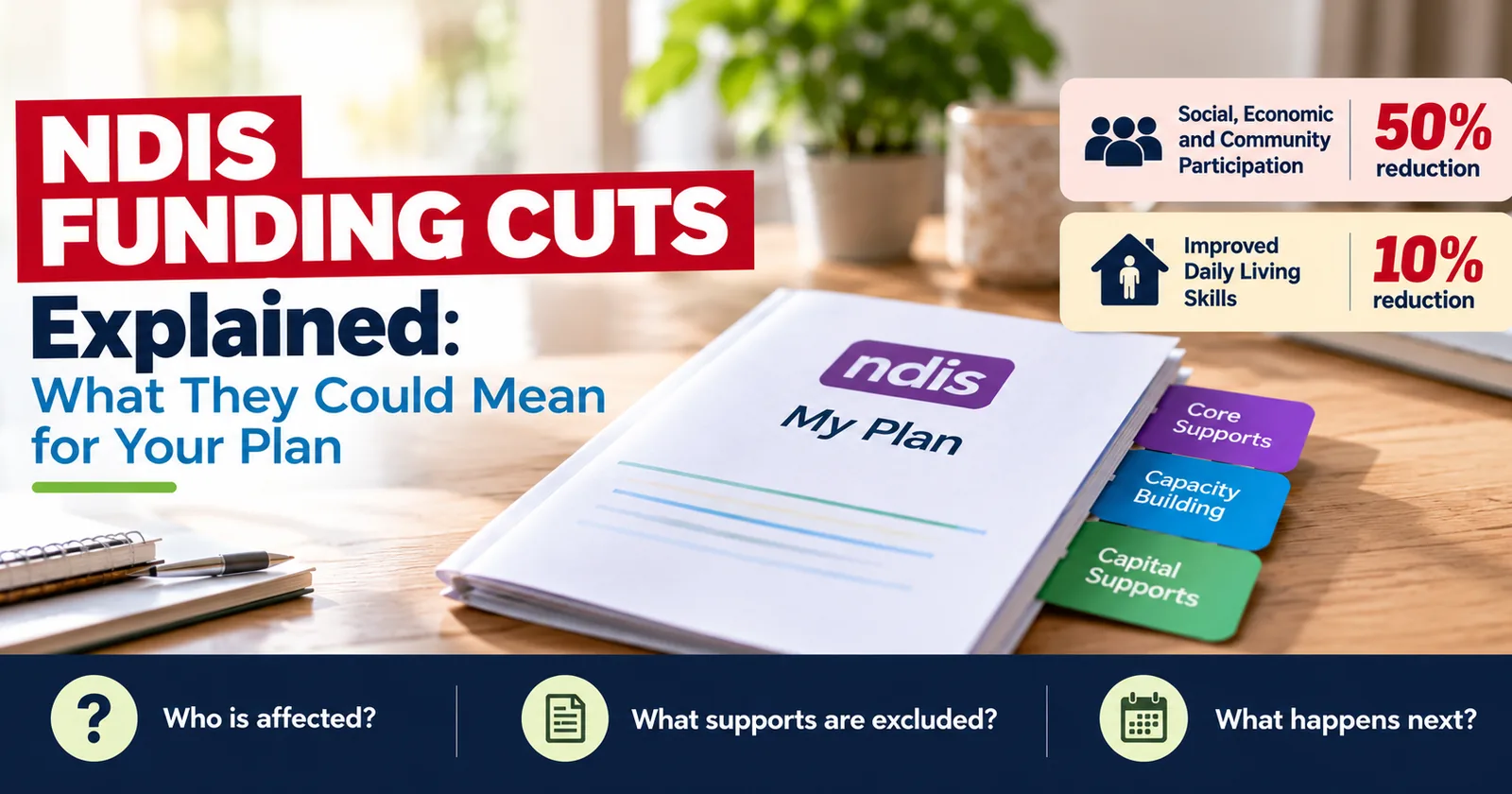
- Social, Economic and Community Participation — the reduction is 50% of affected funding.
- Improved Daily Living Skills — the reduction is 10% of affected funding.
You may recognise these by their previous names. The NDIS previously called Social, Economic and Community Participation ‘Social, Civic and Community Participation’, and Improved Daily Living Skills ‘Capacity Building – Daily Activities.
The Support Determination specifically excludes some supports within these groups from the reduction
The impact will depend on your individual plan, the supports you use and when the NDIA reassesses or renews your plan.
Could my NDIS plan be affected?
Possibly, but the changes do not apply to every plan in the same way.
The support determination applies to old framework plans that come into effect on or after 1 October 2026.
The law uses the term “old framework plan” for plans under the existing planning arrangements.New framework plans are due to begin progressively from April 2027, and the current support determination does not apply to those new framework plans.
This distinction matters because references to a “new plan” during the transition can mean a newly created or reassessed old framework plan — not necessarily a plan under the new framework planning system.
These funding cuts do not automatically happen to everyone on the same day. Your current plan continues until a replacement, reassessed or renewed plan takes effect.
When could the funding cuts affect my plan?
The changes take effect gradually.
From 1 October 2026, the reductions can apply when the NDIA creates or reassesses an affected old framework plan.
From 1 February 2027, they also begin applying through plan renewals for participants who have not already had the changes applied.
The Government expects the transition to continue until 30 September 2027.
If the NDIA has not yet replaced, reassessed or renewed your current plan, you can continue using the funding in that plan until the new plan takes effect.
For plan renewals, the NDIA says it will contact affected participants 60 days before the renewal.
Why is the Government reducing this funding?
The Australian Government says funding for Social, Economic and Community Participation and Improved Daily Living Skills has grown significantly over time and is higher than funding for comparable programs.
It says the reset aims to make funding more consistent with other support programs and support the long-term sustainability of the NDIS.
The legal basis for the reductions is the National Disability Insurance Scheme (Support) Determination 2026, made under the National Disability Insurance Scheme Act 2013.
Does this mean I will lose 50% or 10% of my whole plan?
No.
The percentages apply only to affected funding within the two specified groups of supports. They do not apply to the total value of your NDIS plan.
The effect will also differ between participants. For example, the amount of funding previously available in a category may not be the same as the amount a participant was actually using.
You should look at your own new or reassessed plan rather than assume that another participant’s reduction will apply to you in the same way.
Which supports are excluded from the cuts?
The Support Determination specifically excludes some supports within the affected groups from the reductions.
These include:
- supports in employment
- disability-related health supports
- high intensity supports
- intensive and complex behaviour supports
- customised and wearable technology
- hearing services
Other important supports are also outside these funding reductions, including assistance with eating, drinking, dressing and toileting, household supports such as laundry and cleaning, nurse care, medication assistance, home and vehicle modifications, personal mobility equipment and Specialist Disability Accommodation.
When applying the reductions, the NDIA checks whether your plan contains excluded supports. Where an exclusion applies and the participant has already used funding for those supports, the reduction does not apply to that funding.
This is another reason to look carefully at the funding shown in your new plan rather than relying only on the broad category name.
Can I appeal or ask for a review?
The funding reduction created by the support determination is not itself a reviewable decision.
However, participants can still ask for their plan to change if there has been a significant and ongoing change in their circumstances, functional capacity or support needs.
Only the participant, their plan nominee or their child representative can request an unscheduled plan reassessment.
A plan manager cannot request the reassessment on the participant’s behalf.
The NDIA has 90 days to decide whether a participant is eligible for an unscheduled reassessment.
Participants can speak with their NDIS contact about whether a reassessment or plan variation is the appropriate pathway.
What about participants with very high support needs?
There is a separate safeguard for some participants who need funded disability supports 24 hours a day. A separate instrument, the National Disability Insurance Scheme (High Support Needs Participants) Determination 2026, sets out this safeguard.
A participant may meet the high-support-needs criteria where:
- their combined budget for Assistance with Daily Life, Home and Living, and Assistance with Social, Economic and Community Participation is $215,030 or more, and
- they receive 24-hour NDIS supports for disability-related support needs.
An eligible participant must request the high-support-needs variation within 90 days after the NDIA approves the plan containing the budget reduction.
The participant, their nominee, child representative or a public guardian with a valid legal order can request the variation. Anyone else helping to make the request needs the participant’s consent.
If the NDIA approves the variation, it may increase funding for Home and Living or Assisted Daily Living supports so the participant can continue to receive safe 24-hour support.
This does not mean the NDIA simply adds the original reduction back into the Social, Economic and Community Participation budget.
What should I check when I receive a new or renewed plan?
Compare the new funding with your previous plan, particularly:
- Social, Economic and Community Participation
- Improved Daily Living Skills
- any excluded supports you use
- funding needed for essential day-to-day supports
If you use a plan manager, they can help explain the budgets shown in the plan, monitor spending and tell you how much funding remains.
A plan manager does not decide how much funding the NDIA includes in your plan and cannot overturn an NDIA funding decision.
If your support needs or circumstances have changed significantly and on an ongoing basis, speak with your NDIS contact about whether a reassessment or variation may be appropriate.
What should participants take from these changes?
The funding cuts are significant, but they are not an across-the-board reduction to every participant’s entire NDIS plan.
They apply to specified funding within two groups of supports and are being introduced progressively for affected old framework plans.
There are also exclusions and safeguards designed to protect particular supports and participants with high support needs.
The effect on your own plan will depend on your circumstances, the supports you use and when your plan is reassessed or renewed.
Because the NDIS is currently changing, check the latest official information rather than relying on another participant’s circumstances or older information online.
For the latest official information, see the NDIA’s page “Changes to support budgets from 1 October” and the Department of Health, Disability and Ageing’s page “Funding changes for NDIS supports”.
At Ormeau Plan Managers, we can help participants understand the financial side of their plan-managed budgets and keep track of spending. We cannot make or change NDIA funding decisions.
Sources and further information
- Changes to support budgets from 1 October (opens in a new tab) NDIS
- Funding changes for NDIS supports (opens in a new tab) Department of Health, Disability and Ageing
- National Disability Insurance Scheme (Support) Determination 2026 (opens in a new tab) Federal Register of Legislation
- What is an NDIS plan (opens in a new tab) NDIS
- Changes to plan reassessments (opens in a new tab) NDIS
- National Disability Insurance Scheme (High Support Needs Participants) Determination 2026 (opens in a new tab) Federal Register of Legislation
General information only. This article provides general information about the NDIS and plan management and does not take into account your individual circumstances. For information about your NDIS plan, funding or eligibility, contact the NDIS. Our team can help with general questions about plan management and our services.
Share this article
Have a question about your plan?
Register with Ormeau Plan Managers, or get in touch and our team will answer your questions.