NDIS 90-day claims changes: what happens from 15 October and 1 December 2026?
Two NDIS claiming changes begin in October and December 2026. Learn how extra checks and the new 90-day deadline may affect claims and payments
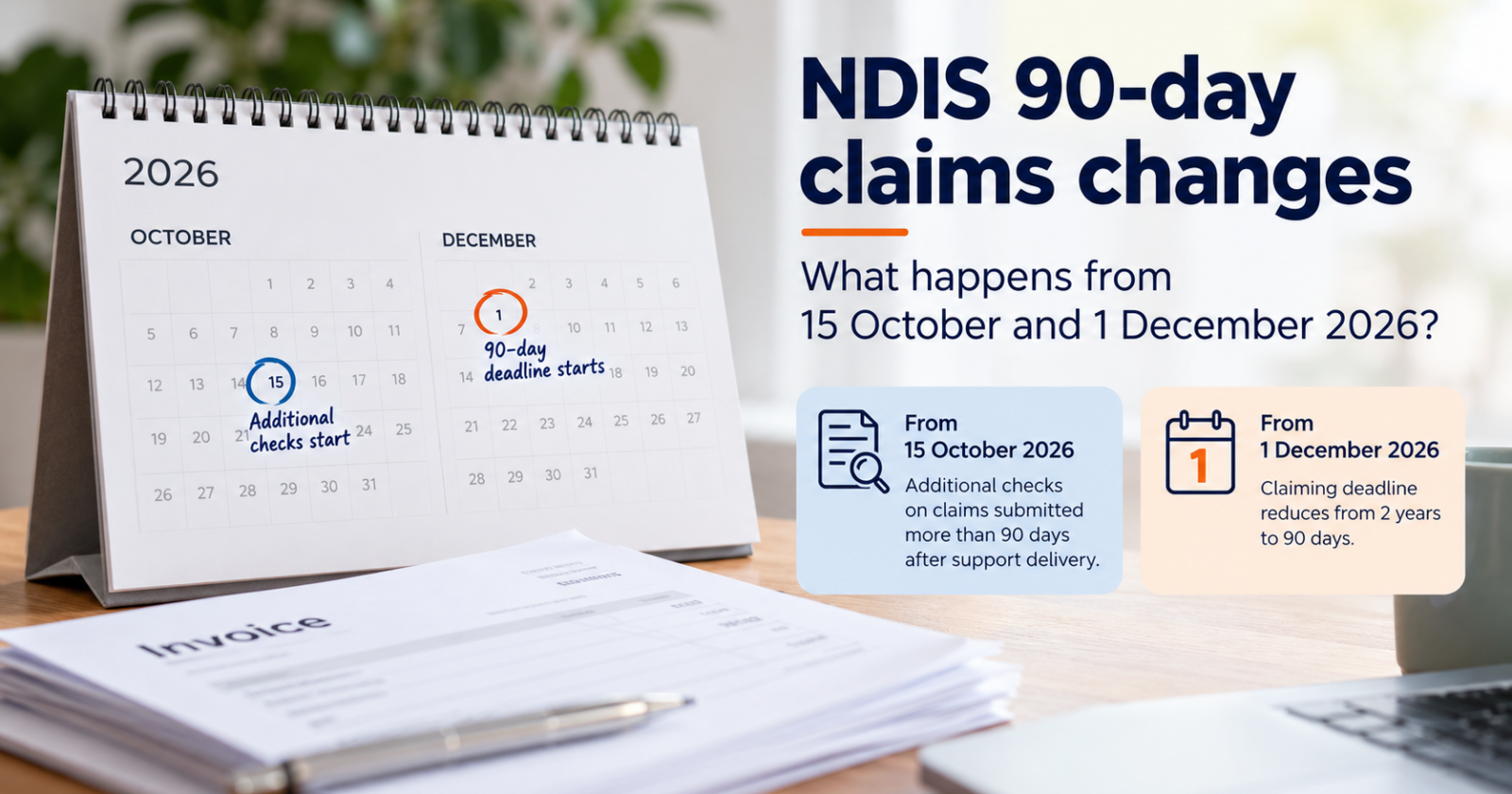
The NDIS 90-day claims changes introduce two important developments in late 2026. From 15 October, claims submitted more than 90 days after a support is delivered will face additional checks. From 1 December, the time allowed to make a claim is scheduled to reduce from two years to 90 days.
What are the new NDIS 90-day claims rules?
There are two separate changes, and it is important to understand the difference.
From 15 October 2026: additional checks on older claims
From 15 October 2026, the National Disability Insurance Agency (NDIA) is applying additional integrity checks to claims submitted more than 90 days after a support is delivered. You can read more in the NDIA’s official announcement about additional integrity checks on older claims.
- Claims submitted within 90 days continue through the usual claiming process.
- Claims submitted more than 90 days after support delivery will be subject to additional checks.
- Older claims may be held for up to 28 days while checks are completed.
- The NDIA may request further information or evidence before paying a claim.
A claim submitted on day 90 falls within the 90-day period described by the NDIA. The additional checks apply to claims submitted more than 90 days after support delivery.
The additional checks do not, by themselves, mean a claim will be rejected simply because it is more than 90 days old. A claim may still be rejected if it does not meet other applicable claiming requirements.
From 1 December 2026: a shorter claiming deadline
A separate legislative change is scheduled to reduce the time allowed to make claims for NDIS supports from two years to 90 days after service delivery. This is different from the October integrity checks: it establishes a shorter period for making a claim. You can read more in the Australian Government’s guidance on the 2026 NDIS changes.
What is the current NDIS claiming time limit?
Under the current arrangements, the general time limit for submitting an NDIS claim is two years from the support start date. The limit began on 3 October 2024, with a 12-month grace period. From 3 October 2025, NDIA systems began automatically rejecting claims submitted more than two years after the support start date.
The December 2026 change will substantially shorten the claiming period.
Why is the NDIA introducing additional checks?
The NDIA began strengthening checks on older claims in June 2026, initially focusing on claims submitted more than 12 months after support delivery. The checks were progressively extended, with the 90-day threshold commencing on 15 October.
The NDIA explains that older claims may be harder to verify because records can be difficult to obtain and information may no longer be accurate. The checks are intended to improve claim accuracy and protect NDIS funding.
Will claims older than 90 days be rejected?
Between 15 October and 30 November 2026, a claim will not automatically be rejected under the new integrity-check process simply because it is over 90 days old. Instead, additional checks or requests for evidence may apply. Claims must still meet all other requirements, including the existing two-year time limit.
From 1 December 2026, a legislated 90-day claiming timeframe is scheduled to commence. Claims outside this timeframe may not be payable under ordinary claiming rules. Whether any exceptions or transitional provisions apply to a particular claim needs to be checked against the legislation and further official guidance.
What about supports delivered before 1 December 2026?
The Australian Government has confirmed the planned 1 December commencement. However, at the time this article was checked, detailed official guidance could not be confirmed about how the new timeframe will apply to every claim for supports delivered before that date.
Do not assume an older invoice will remain claimable after 1 December just because it was issued before the new rules begin. Equally, the outcome of a particular claim should not be assumed without checking the relevant rules, any transitional provisions and any available exceptions.
Providers and participants with outstanding older claims should check current NDIA guidance and seek clarification for their circumstances.
When does the 90-day period start?
The October integrity checks and the announced December timeframe are described by the NDIA and Government with reference to when a support was delivered, rather than when an invoice was prepared or sent. Sending an invoice later does not, by itself, restart that timeframe.
For supports delivered over several days or on an ongoing basis, identifying the relevant date may require closer consideration. The current two-year limit refers to the support start date, while the new guidance refers to support delivery. Providers should check official claiming guidance rather than assume that the first or last day always applies.
What does this mean for NDIS participants?
If your funding is plan-managed, providers generally send invoices to your plan manager for processing. You may still need to confirm that supports were delivered or answer questions about an invoice.
- Encourage providers to send invoices promptly.
- Check invoice details and raise concerns about incorrect charges or support dates.
- Respond to requests for information from your plan manager.
- Keep relevant records of supports received.
- Ask about outstanding invoices or claims you are unsure about.
If you self-manage your NDIS funding, timely reimbursement claims are also important as the shorter claiming timeframe approaches.
What does this mean for NDIS providers?
For plan-managed funding, sending an invoice to the plan manager is not the same as submitting a claim to the NDIA. Invoices may need to be checked, clarified or corrected before a claim can be submitted.
- Send invoices regularly, soon after delivering supports.
- Make sure support dates, descriptions and other invoice details are accurate.
- Keep appropriate records showing supports were delivered.
- Respond promptly to requests for corrections or evidence.
- Review older outstanding invoices rather than letting them accumulate.
What happens if an older claim requires extra checks?
From 15 October, claims submitted more than 90 days after delivery may be held for up to 28 days while the NDIA undertakes additional checks. Further information may be requested. This does not mean every such claim will take an extra 28 days.
How can a plan manager help?
A plan manager helps with the financial administration of plan-managed NDIS funding, including receiving and checking invoices, submitting claims, paying providers and maintaining financial records. A plan manager may also help clarify invoice issues and claim status, but cannot guarantee NDIA approval or override legislated claiming limits.
What should participants and providers do now?
- From 15 October 2026, claims more than 90 days after support delivery face additional integrity checks.
- The existing two-year claiming limit applies before the new timeframe commences.
- From 1 December 2026, the claiming period is scheduled to reduce to 90 days.
- Detailed treatment of some older claims may depend on transitional rules or exceptions needing further clarification.
- Prompt and accurate invoices and claims can help avoid unnecessary delays.
For current information, see the official NDIA announcement about older claims and the Australian Government guidance on the 2026 NDIS legislative changes.
Information last checked: 15 October 2026. The application of claiming rules to individual circumstances may depend on the relevant legislation and NDIA guidance.
Sources and further information
- Increasing integrity checks on older claims (opens in a new tab) National Disability Insurance Agency (NDIA)
- About the 2026 NDIS legislative changes (opens in a new tab) Australian Government Department of Health, Disability and Ageing
- Claim time limit starts soon (opens in a new tab) National Disability Insurance Agency (NDIA)
General information only. This article provides general information about the NDIS and plan management and does not take into account your individual circumstances. For information about your NDIS plan, funding or eligibility, contact the NDIS. Our team can help with general questions about plan management and our services.
Share this article
Have a question about your plan?
Register with Ormeau Plan Managers, or get in touch and our team will answer your questions.